There are controversies in the opening week of the biennale, calls for the exhibition to be more ‘inclusive,’ to better serve the public. The headlines keep coming. But, to me, this echoes the governing logic of this continent, one in which the centre dictates to the margins the terms of its inclusion. All the ways it is conditional.
There’s a scene in Beloved, where a character called Paul D—who lived alongside Sethe at Sweet Home—touches a scar on her back. The intricate lines are etched on her skin, in the shape of a chokecherry tree, a corporeal reminder of past cruelties. So often, the struggle between history and memory plays out on the body. But the body—despite attempts to control or contain—can resist the stories imposed on it. It can imagine new ways to be.
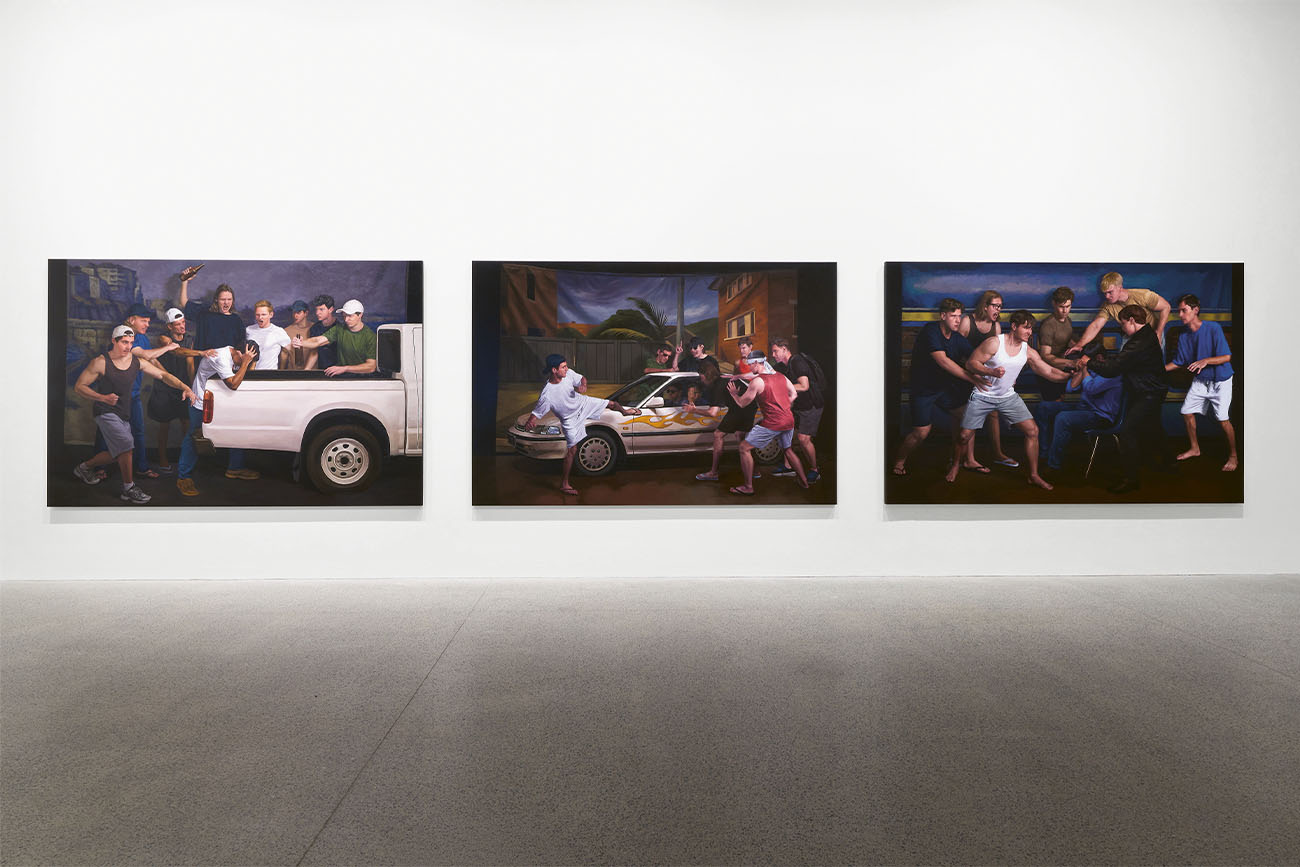
On the ground floor of Sydney Modern, alongside a display of bouquets, designed to wither and wilt by Canadian artist Kapwani Kiwanga—charting the transfer, from colonial rule, to independence, across the African continent, I am jolted by Abdul Abdullah’s paintings of the Cronulla Riots. Here, Abdullah, an artist with Malay-Indonesian and settler-convict ancestry, recreates one of the country’s defining examples of racial violence—an assault, in 2005, that saw 5000 mostly white Australians attack bodies of Middle Eastern appearance on Cronulla Beach, south of the city.
In one work, a young man is poised to strike, a beer bottle in hand, while another cowers over a white ute, a symbol of Australian masculinity, and in another, a figure in white shorts is mid-kick, addressing a row of muscled opponents. Abdullah renders these scenes with all the acuity and gravitas of a Renaissance painting—the colours rich and vivid—pointing to the fact that these scenes, that we think of our past, are still fermenting in this culture, still shaping the psyche of a country in which those marked out as others are treated, always, as invaders and far-right politicians, such as Pauline Hanson, are rising again.
The week I see the show, I watch an interview with Nikesha Breeze, who—meditating on Living Histories—talks about how gauze, the material of her work, originated in Gaza.
I stand, floored, in front of the Ngurrara Canvas II, an extraordinary painting, made by 40 artists from the Great Sandy Desert, installed, opposite Teklehaimanot’s collages, on an eighty-square metre platform. Its lines and circles, swirling and intricate, recalling jila—or waterholes—that challenged the colonial legal system by asserting an ancestral connection to country.
I admire Code Black/Riot (2025), a photographic series at the Chau Chak Wing Museum and video work at the Campbelltown Arts Centre in which Hoda Afshar, Behrouz Boochani and Vernon Ah Kee centre the stories of Indigenous youth who have been incarcerated. The boys and girls in Afshar’s evocative portraits look at the viewer, but cover their faces, refusing our gaze, resisting this brutal system by insisting on their privacy and dignity.
And in a darkened space at the Art Gallery of New South Wales, I am touched by an elegant sculpture by Taysir Batniji, rows of olive oil soap—part of a centuries-old Palestinian tradition—inscribed with the Arabic saying dawam el hal men al mohal’, or ‘no condition is permanent.’ The soap, ordinary and yet so intimate is part of the way we tend to ourselves, but in Rememory, the artist invites the audience, at regular intervals, to take a bar home with them and I think about how this hints at the fact of our shared humanity and how our bodies are continuous, depending on each other to heal.