Brook Andrew
NIRIN, a match with love
Publié le 27/05/2026

La revue des biennales d’Art contemporain – Numéro 3 – Biennale de Sydney
NIRIN, a match with love
Publié le 27/05/2026
NIRIN, the 22nd Biennale of Sydney, was a profound moment for me. At first, I was taken back that a biennial would invite an artist, as not many biennials take this direction as a shake up to the usual form—of course, many artists have been appointed artistic directors of international biennials before. But as an artist who was born in Sydney on Gadigal Country and grew up within strong First Nations and migrant communities, it was a dream come true.
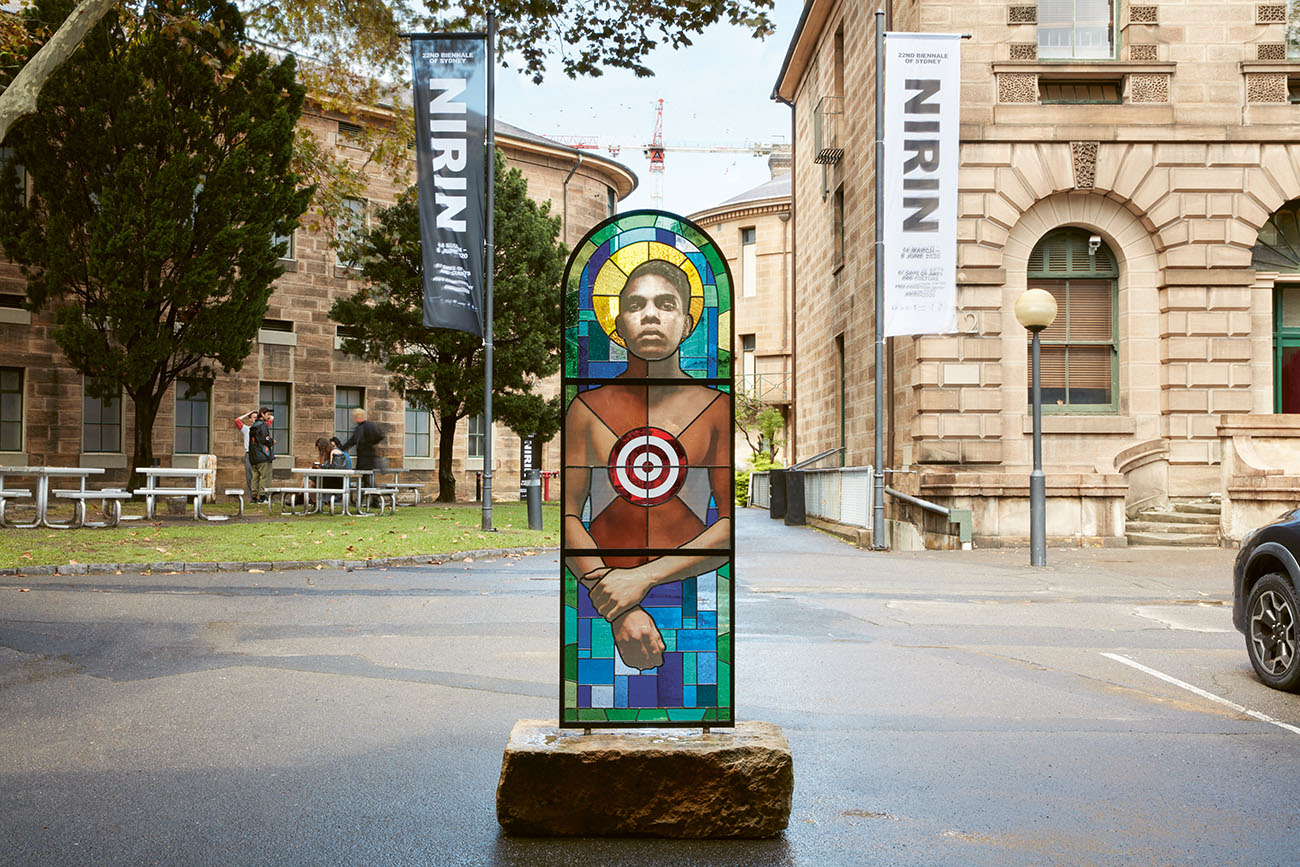
I got to work quickly. I negotiated the reconfiguration of the historic Old Court Galleries at the Art Gallery of New South Wales to insert Arthur Jafa’s installation The White Album amongst the backdrop of the painting The Visit of the Queen of Sheba to King Solomon (1881-1890) by Sir Edward John Poynter—a space long steeped in Western biased tradition. Cockatoo Island, with its raw, layered history of quarrying and shipbuilding, is a labyrinth of possibilities not usually given to artists. It felt like stepping into a “fun house” of abandoned structures charged with memory, inserting works by Paulo Nazareth and Nicholas Galanin, which staged the excavation of the colonial statue of Captain Cook. It was all on: artists were experimenting and bending rules to get around Western frames of hidden racism, fear or simple ignorance. The result was an explosion of experimentation and tongue in serious cheek—it was a different kind of historic war we were dealing with back in 2020.
At the National Art School, the original British gaol for convicts, Teresa Margolles’ powerful, haunting works involved complex inclusions of local trauma. Some venues, like the Museum of Contemporary Art and the Art Gallery of New South Wales, reflected European “white cube” traditions. Others echoed artist-run initiatives such as Artspace, or were embedded in Western Sydney, like Campbelltown Arts Centre, which stands proudly on Dharawal Country. I couldn’t simply use these spaces—I had to transform them. During NIRIN, they became sites of challenge and possibility, reshaped to confront Western-centric histories and to foreground First Nations and expansive contemporary practices.
I chose the title NIRIN for the biennial, a Wiradjuri word from my grandmother’s Country meaning “working on the edge”. It holds more than a literal meaning—it speaks to overlaps, to edge meetings and forming a new centre. The biennial became a constellation: artists long positioned at the margins coming together, through exploration and solidarity. It was like love match-making. Many of them had never gathered in this way before, converging on Indigenous lands in Sydney. That energy—of arrival, connection, and presence—was powerful.
NIRIN was, first and foremost, an artist and community-led biennial. It may have appeared political, but at its core it was an act of solidarity—grounded, honest, and real. It was about working with friends and collaborators, weaving kinship through Indigenous and self-determined methodologies of survival, celebration, and care. The exhibition held multiple ideas at once: alternate narratives, juxtaposition, and new ways of seeing. Artists, objects, and museum collections came together to open different possibilities.
Many artists arrived in Sydney with little understanding of Australia’s layered histories, deep connections and similarities to other parts of the world. Those connections surfaced in unexpected ways—for example, eucalyptus as both a healing and destructive force, stretching from Algeria and India to the Americas; histories on the environment, slavery and apartheid also echoed. These entanglements mattered.
We aimed for each artist and experience to resonate—whether through the sound environments of artist and healer Lhola Amira or the journeys shaped by musician, linguist, and artist Mayunkiki, for example. I often held a simple test: if my grandmother couldn’t connect with the works, something was missing. And some experiences were wild. Ibrahim Mahama’s installation on Cockatoo Island was transformative, as was the performance led by Latai Taumoepeau.
Communication, process, and authenticity guided me. What mattered was how people felt—how they connected with each other. Elder Indigenous artists and community members could meet for the very first time, such as Māori Elder and artist Emily Karaka meeting the families of the late Pitjantjara artist Kunmanara Mumu Mike Williams, both powerful land rights activists leading social change.
I was interested in memory, memorialisation, and shifting realities, as well as how protocols of artists, alongside smoking ceremonies and Indigenous protocols of Welcome to Country, were customs of pride and strength within the very fabric of the biennial itself. I saw my role as a catalyst: the artists carried the work and we supported it with a dedicated community, with people such as Paschal Daantos Berry and Cherie Schweitzer. As an artist I know what artists really need, and it’s not to be caught up in the mayhem of bureaucracy. But nothing is perfect; we kept the flow going as much as possible.
I made a deliberate decision not to include artists who had previously shown at the Biennale of Sydney. It was difficult but ultimately illuminating. NIRIN became about healing, sovereignty, environment, and collective action.
There were also powerful cross-disciplinary gestures. Nicholas Galanin, Dan Rizk (MzRizk) and Hannah Catherine Jones (Foxy Moron) performed as DJs at the opening, generating a joyful, collective energy. Sarah Houbolt brought performance, disability advocacy, and physical theatre into the exhibition. Bankstown Poetry Slam, from the local Blacktown community, activated language and voice. These were not separate practices—they formed a shared ecosystem. And reflecting on ecosystems, issues of repatriation and restitution lived through the work of Katarina Matiasek, who collaborated with Australian Indigenous Elders regarding the return of important cultural materials from Austria to Australia.
The aim was for people to leave with a sense of self-representation—not simply ticking off names. Australia, like the world, is deeply diverse. NIRIN stood with artists who often move through shadowed spaces, yet carry their own light—expressing protest, desire, complexity, and play.
At its core, this biennial was about respect: confronting racism, exclusion, and environmental crisis, while recognising that interconnection offers pathways toward familiarity, even family. It was also about the efficacy of art: its ability to build solidarity and connect communities and scientists, who were also part of NIRIN.
There is a hunger for change. NIRIN responded to that—acting as a catalyst, a constellation of voices, and a gesture toward a future where we come together.
Brook Andrew