Skip to content

Nikesha

Breeze

Nikesha Breeze

Nikesha Breeze

Publié le 05/05/2026

The archives live in our bodies, our souls, and our minds

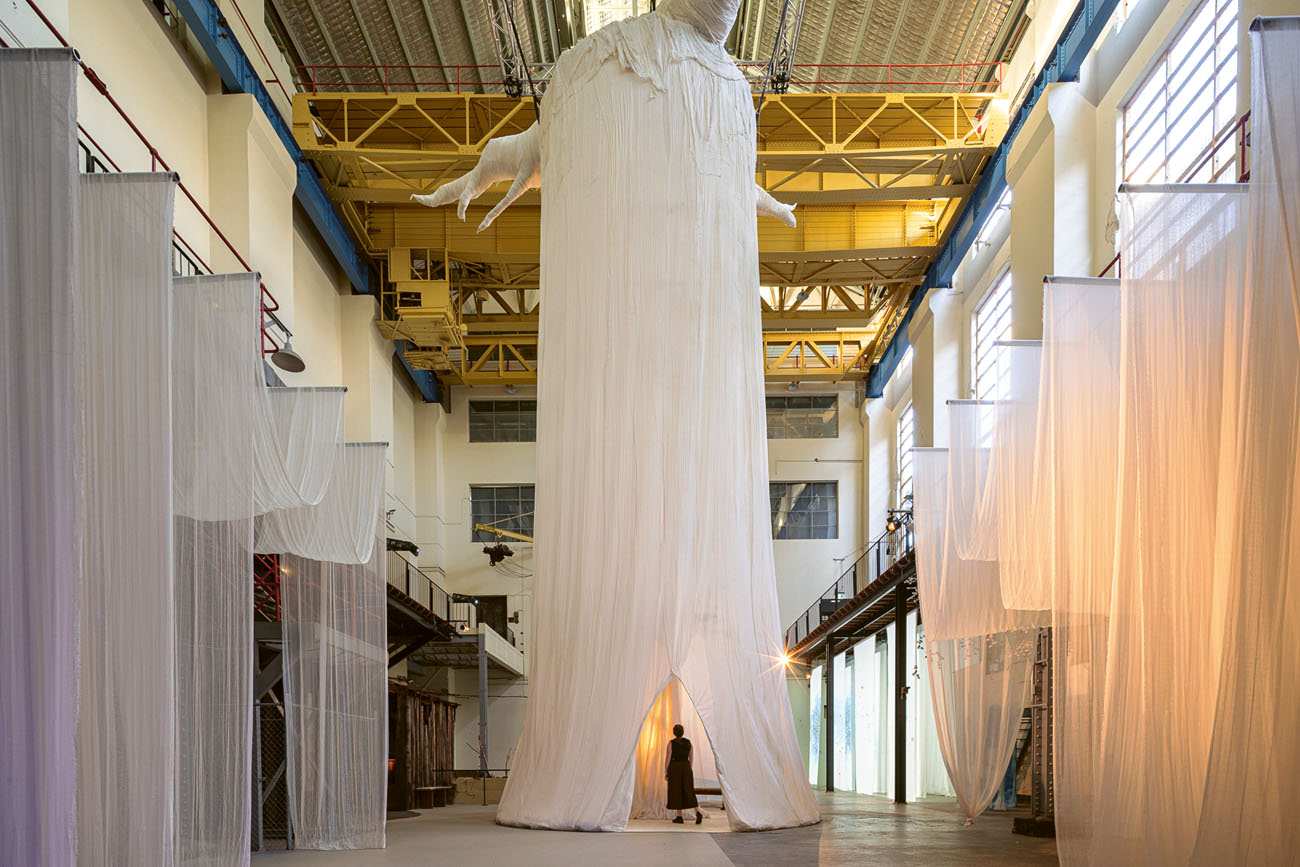
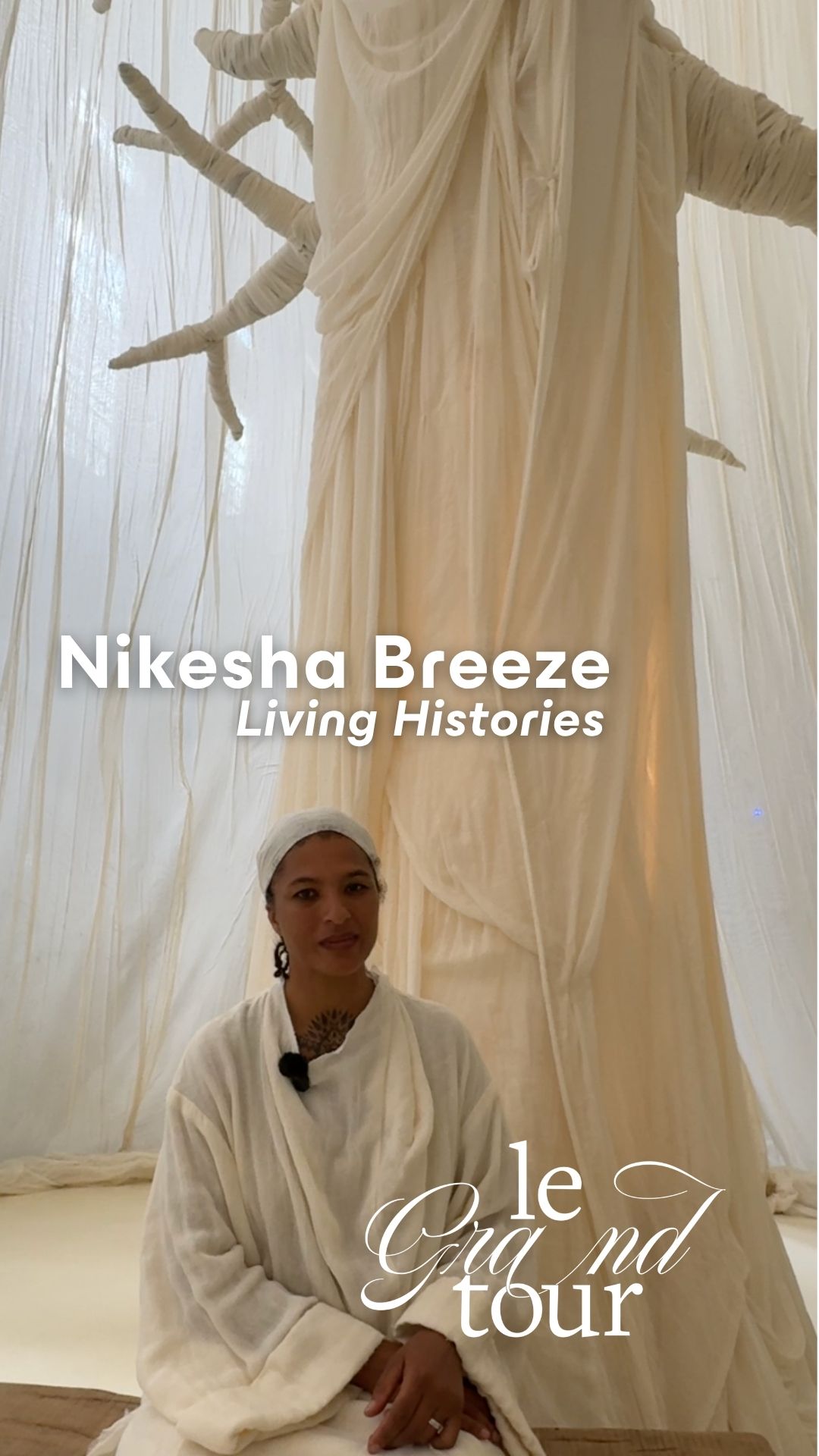
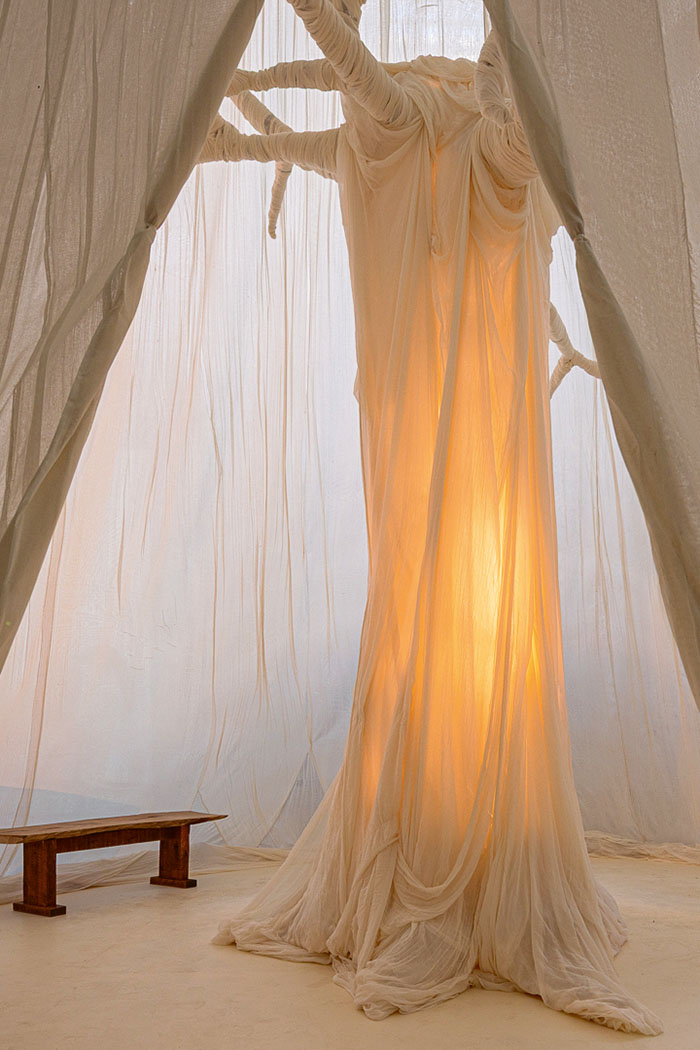
In the turbine hall of the White Bay Power Station, a massive white baobab appears unexpectedly. Draped in cotton veils, it seems to float weightlessly, despite its dizzying height—its branches brush the ceiling from the second floor. Is it a mirage? Intrigued, the visitor quietly approaches the ancient tree. Dressed all in white, Nikesha Breeze (born in 1979) invites us to step inside. 

We enter the installation as if entering a sanctuary, our hearts open to introspection and contemplation. We wander, we linger, we listen to the stories of those whose memories the artist revives here. Then comes the waiting, a moment suspended in time, in the calm offered by the thousand-year-old tree, away from the bustle of the biennial. The light there is soft.  

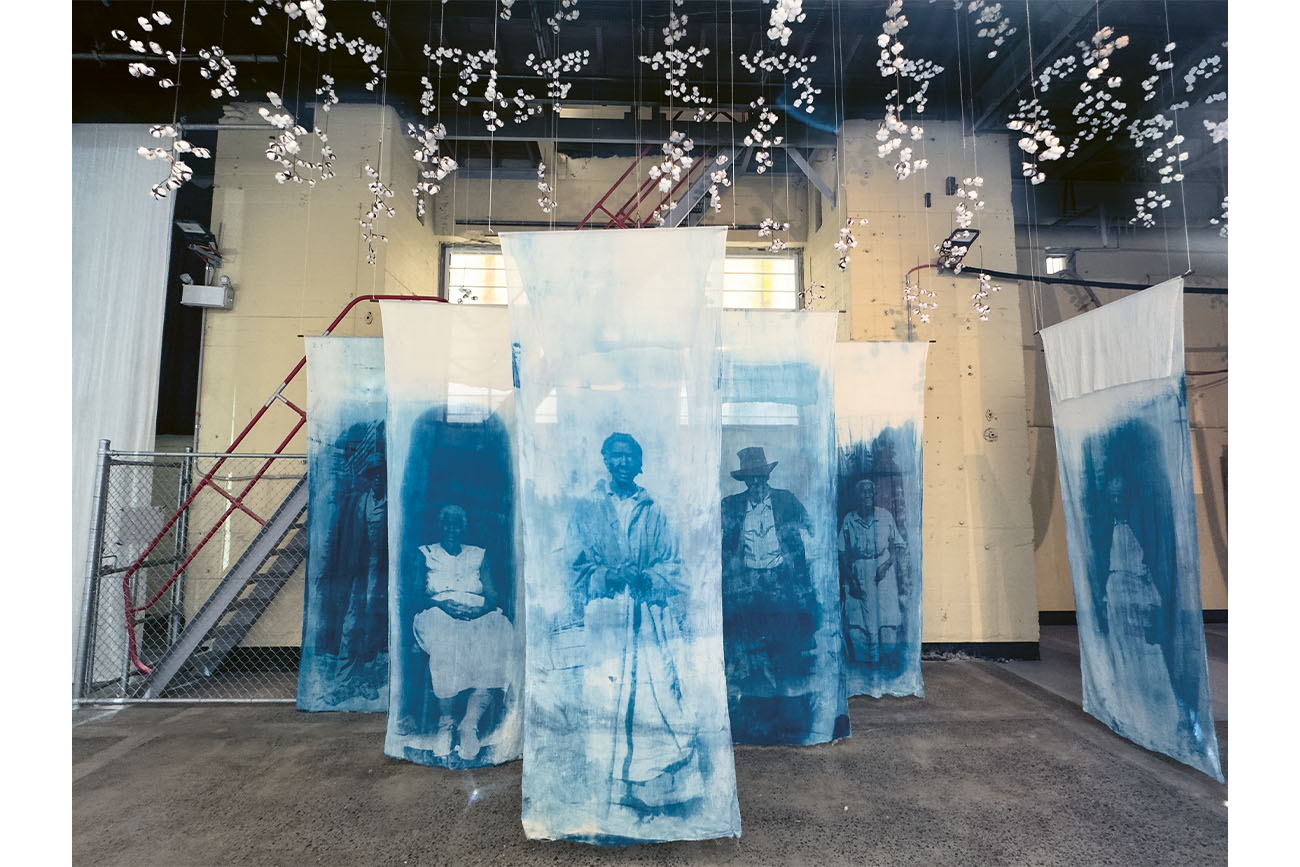
As we walk out, the voices of former enslaved people surface in a whisper. We must draw near, almost in prayer, to catch a few fragments. In a wooden hut, photographs, newspapers, dishes, and other furniture seem suspended in time, as if deliberately left behind. Further on, majestic faces emerge from immense cyanotypes printed on cotton panels.

A song rises, soon joined by percussion. The performance has just begun. 

Here, the archives don’t just get read—they’re something we can feel and experience.
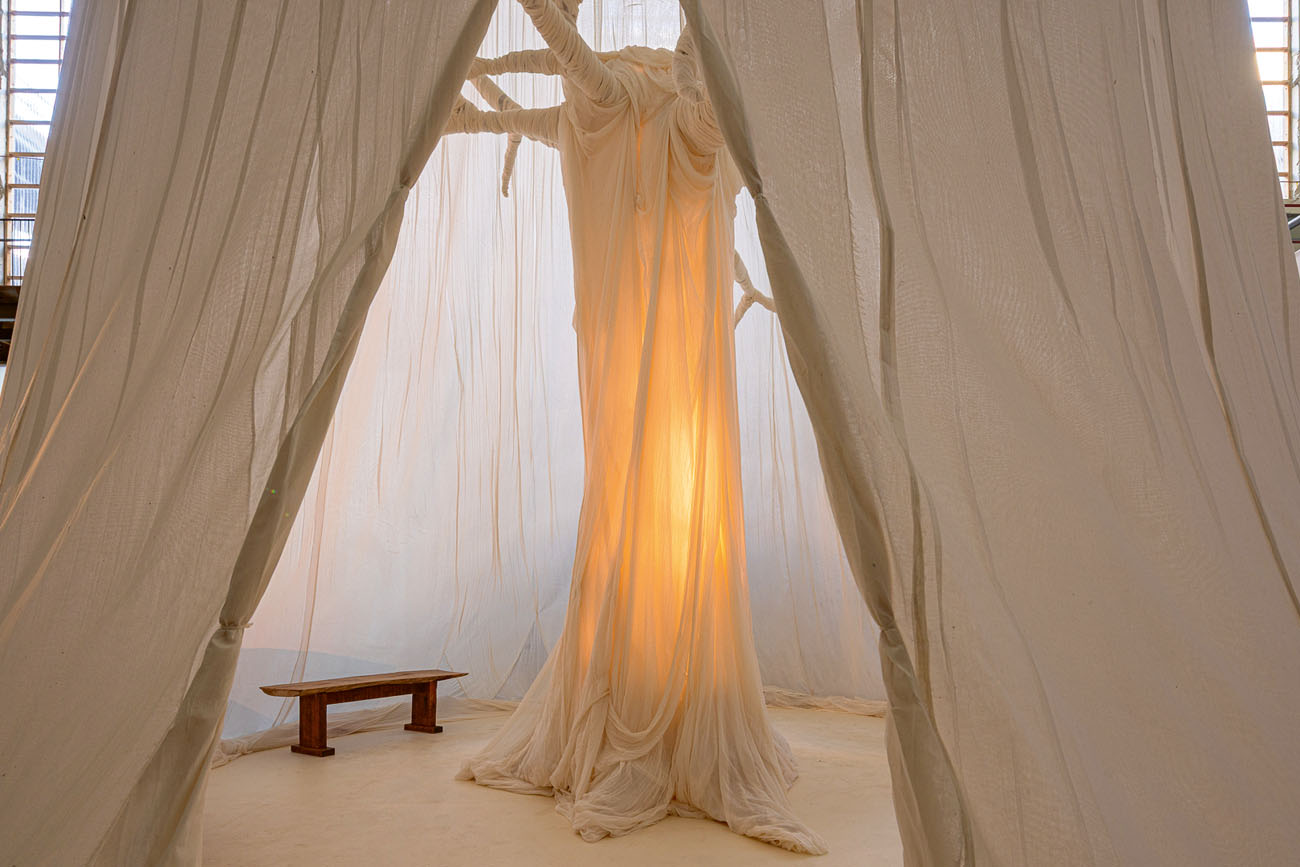
Le Grand Tour (LGT) : There is something fascinating about your work. I must admit that I was particularly moved when I first saw it here, in the turbine hall of the White Bay Power Station. First, because of its sheer scale—that immense cotton tree seems to fill the entire space from floor to ceiling—but also because of its richness and complexity. Living Histories is a monumental installation that draws on a multitude of mediums, imaginations, and narratives, with the heavy history of slavery as a backdrop.

Nikesha Breeze (NB) : My whole practice is dedicated to reclaiming archival histories. But when you start digging into archives, certain questions arise: how can we hold so much humanity, pain, joy, suffering, revelation, and communion? How do we really hold them? Because it’s one thing to grasp them in your mind or read them on a piece of paper, but it’s quite another to truly feel them, physically, in all their complexity. From the very beginning, I wanted something big. I wanted to allow people to step inside a space. At the same time, I wanted the atmosphere to remain intimate so that you really feel like you’re sitting at a table with an elder, having to lean to hear their old voice, to catch their words, and to wait during their long pauses. These are stories that call for patience. That’s how the project began to take shape.

LGT

What stories inspired you to create this work?

NB

In the 1930s, the U.S. government launched a program called the Federal Writers’ Project (FWP), whose goal was to collect the folklore and history of the American people of that period. They sent hundreds of writers throughout seventeen states in the southern United States. They found that the stories told by former enslaved individuals were rich with information about their culture, historical facts, and details that existed nowhere else. Many of these people—if not all—had lived through the end of slavery. This meant they had been treated like animals; that their names, family histories, lineages, and traditions had not been recorded like those of other human beings. In 1867, some of them wrote their names for the first time in order to be counted as citizens. These same people who had escaped slavery or survived it had nowhere to tell their personal stories. The FWP project therefore aimed to save their stories before they disappeared. Many were between 70 and 120 years old. These are thus fragmented, dreamlike, reconstructed accounts, but some are incredibly lucid.

LGT

To a certain extent, Living Histories is a way to bring these voices back to life—or at least to make them visible.

NB

Absolutely. There’s also the idea of honouring their knowledge. They hold a vast body of knowledge, ranging from cultural aspects—such as the foods they prepared and the medicines they used—to practices, like textile creation, or the development of community life around prayer, and the rituals they performed to ward off evil or strengthen their security. These people also described how they built their cabins, their homes, and their beds—everything they made with their own hands. I relied extensively on the archives to conceive this work. For example, when formerly enslaved people needed to find refuge, they would seek shelter in the trees or among the brush arbours. My initial vision was therefore to create a tree-shaped sanctuary—a place where one can enter and feel at peace, and, upon leaving, immerse oneself in the complexity of these stories.

LGT

Living Histories explores the wounds left by the history of slavery in the United States. Yet it seems to draw strong parallels with the history of Australia, which is also marked by a long history of colonization and land dispossession.

NB

Yes. The situation is exactly the same as in the United States: it’s a history of colonization—which is still ongoing—and of a genocide that has not been acknowledged. There have been many conversations surrounding land recognition, but at the same time, the deprivation of Aboriginal peoples’ rights remains a reality. I wanted to bring these histories here. I hope this will inspire communities involved in art and archives in Australia to devote more energy to the preservation and rehabilitation of Indigenous histories, which resonate deeply with our own… We are all in the same boat of trauma and the same quest for reclamation.

LGT

Photography holds a very special place in your work. It appears in the form of small, framed archival prints, as well as huge cyanotypes created on pieces of cotton gauze. What is your relationship with this medium?

NB

I’ve been doing this for a long time, ever since high school, when I was just beginning to develop my artistic vision. I felt in love with photography, and from there, I gradually began exploring alternative processes. That sort of laid the foundation for my practice, but I didn’t think I could “recreate” anything else. Then, about eleven years ago, after a long period in theatre, performance, and photography, I decided to move to the visual arts. I began creating large-scale oil paintings, sculptures, and installations. Over the years, I’ve diversified my practice by exploring many different mediums. And this installation brings them all together in one place. This is the first time I’ve been able to combine my photographic vision and practice with photos I didn’t take myself. All the photos you see here come from the archives, but I’ve combined them with other techniques to present them and bring them to life in the exhibition space, such as sculpture, performance, or immersive reality.

LGT

Speaking of performance, it seems this is just as important a part of Living Histories.

NB

The original vision for this work was that it would feature activations throughout the run of the exhibition, and I have always imagined that performance would be an integral part of its future iterations. It is, once again, a way of breathing new life into the stories. On the one hand, as a viewer, you enter the space with your own body to experience the work; on the other hand, within the performance context, it is the presence of another body, another human being, that enlivens it in the sense that they bring the narratives to life with their own voice. I told the performers that they, too, are the guardians of these stories, and that they embody their ancestors. They come in as spirits, protecting the energy of the place. For me, performance is a process that revitalizes the archives, the knowledge, and the work itself.

LGT

I am mesmerized by this tree draped in cotton gauze. Both light and imposing, simple and monumental, it seems to defy the industrial environment in which it stands.

NB

This power station is, in a way, the embodiment of the capitalist structure that we live in. This site is steeped in history—a history of industry, colonization, and land appropriation. There is beauty here too; I won’t deny it. But symbolically, to intervene in this space is, for me, a radical act of reclamation. In the first version of the project, I had envisioned three trees—all the same size—that would fill the entire space, stretching across the balconies and cutting the walls. When Hoor visited me and asked, “What is your biggest dream?” I told her about this project. I said, “It’s kind of my magnum opus. It’s a very ambitious dream I’ve cherished for many years, and I’ve been looking for the right place to bring it to life.” I needed a big warehouse to display all these interactive sets. I shared my vision for the project with her and laid the whole story out. She was very moved by it. Six months later, she contacted me again and said, “I’ve found the place, you know. We’re going to do it. I have some photos to show you.” At that point, I began designing the project specifically for that location. I arrived in January to build the work on site. It was quite a feat to have been able to do it. For two months, we worked very hard to make it happen. The large tree took us about a month to build, and up to twelve hours to hoist into place. We spent all our time sewing—the structure itself is hand-sewn. Five people helped me wrap the tree. It was incredible. Each of them brought their own vision and heart to the project.

LGT

Cotton runs through the entire body of work; it is omnipresent. Visually, it evokes a sense of majestic lightness, while at the same time reminding us of the heavy history of its cultivation on American plantations. How important was the choice of this material to you?

NB

Every single material plays an active role in the work. What we use and how we use it are of crucial importance in my practice. Cotton is a material steeped in history—especially the history of colonization. Sourcing and working with two thousand metres of gauze—nearly two tons of cotton—is in itself an act of reclaiming it, transforming it into something beautiful, and liberating it from the histories that enslaved this plant as well. Two thousand metres is the amount a single person would pick in two days at the height of slavery. There are also other meanings behind the choice of this material. Gauze was created in Gaza, Palestine, from which it takes its name. It has become an indispensable fabric worldwide for healing wounds and wrapping bodies in shrouds. We wrapped the tree’s branches as one would wrap a wound, because we are truly wrapping a huge wound.

LGT

Time can sometimes help heal wounds. Would you say that this creative process was cathartic?

NB

Absolutely, ands for everyone involved in the project. It was truly beautiful to witness these young Australians, who had been hired to help produce somebody’s art, realize that it was about more than just that. We worked together in a prayer practice that people will be able to feel in the exhibition. It encouraged everyone to slow down. Like you said, time is one of the most powerful ways to reclaim things. The performance I’m doing lasts quite a while itself—about two hours. It’s not a show in the usual sense of the word, because I asked the performers to do things differently and to step outside the framework of production. Slow down, take your time, be patient, get curious, and allow for other things to happen. Stop for a moment, you know, just a moment. That’s the most important thing you can do.

Nikesha Breeze