Skip to content

Ema

Shin

Ema Shin

Artist Ema Shin in residence at the Australian Tapestry Workshop

Publié le 05/05/2026

On ne voit bien
qu’avec le cœur

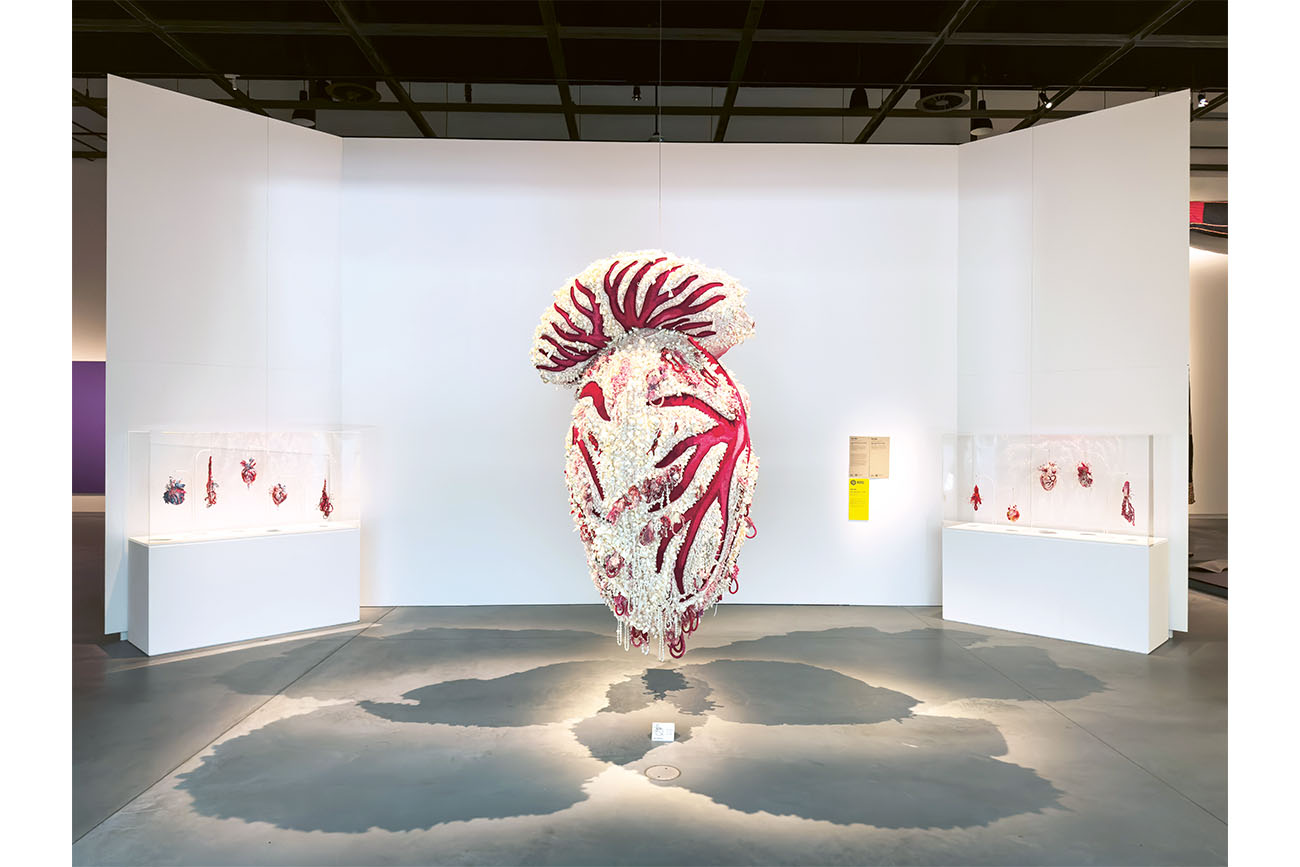
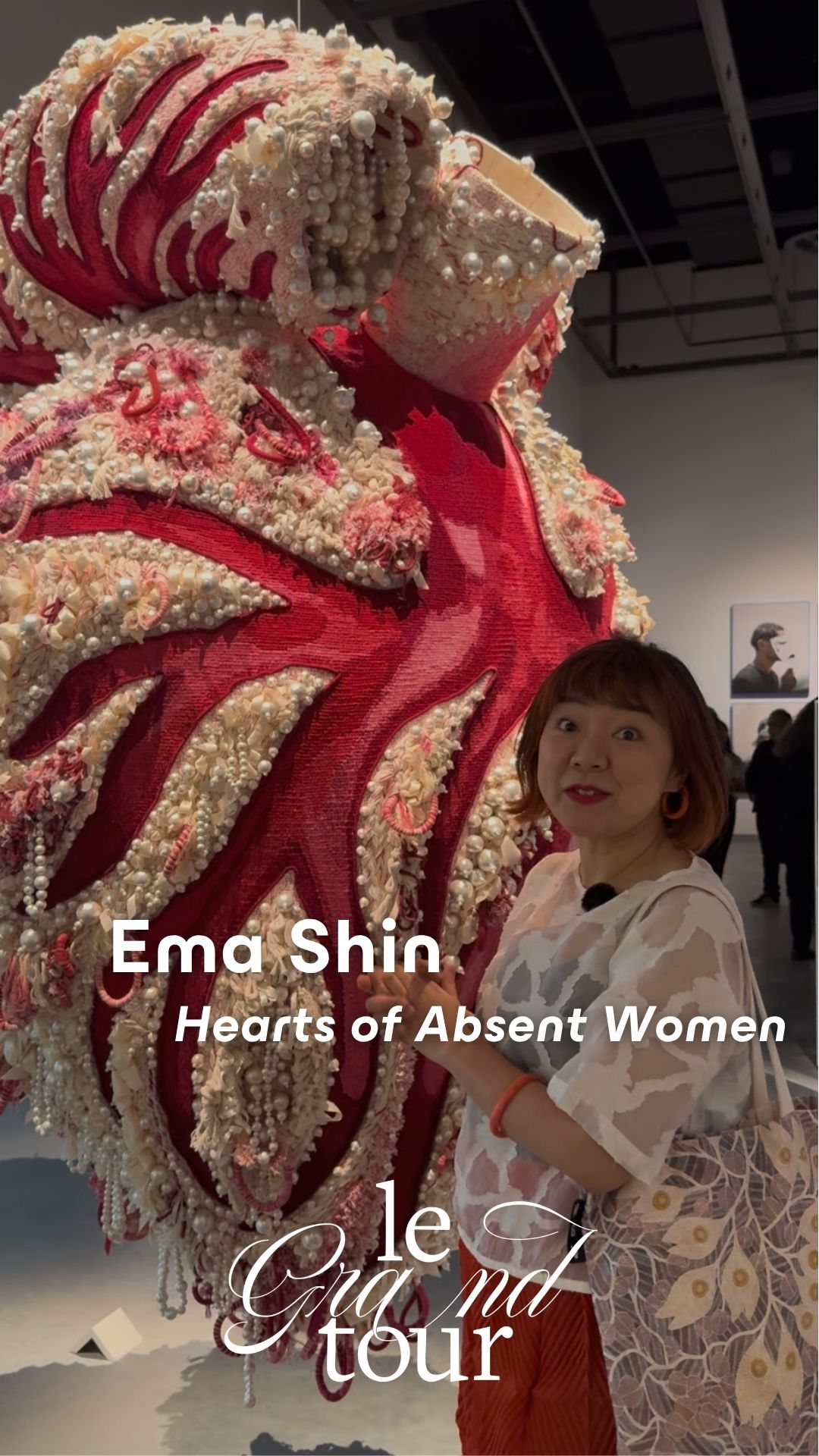
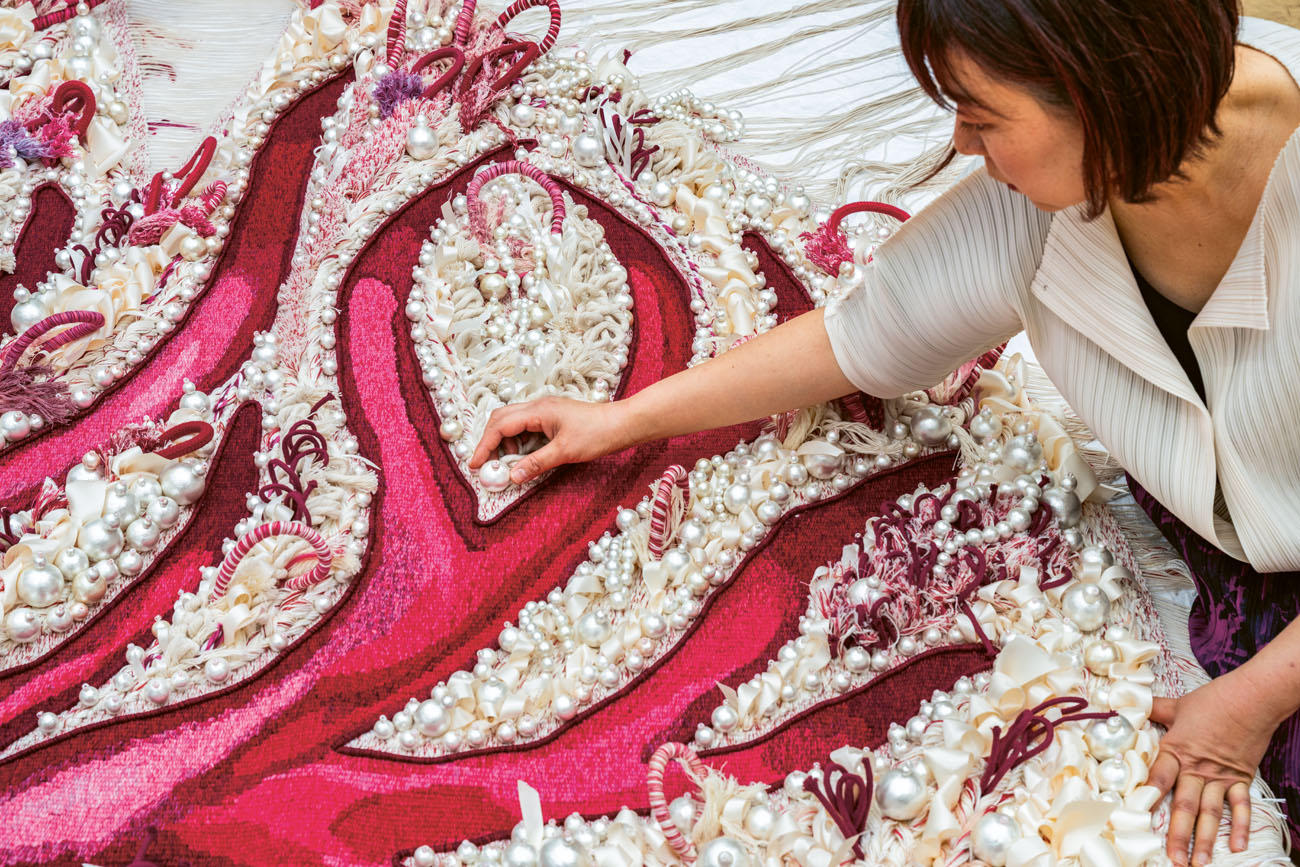
Ema Shin’s sculptures are radiant, mysterious, poetic. At first glance, it is difficult to identify the shape of these delicate organs, which both evoke parts of human anatomy and underwater creatures that would have been removed from their natural habitat. On their surface, an entire ecosystem of threads, beads, flowers, pearls, and embroidery populates these organisms with an abundant network of veins, ropes, and valves finely executed by the artist’s hand. These meticulously crafted sculptures produce a striking, haptic visual effect. 

At the Chau Chak Wing Museum of the University of Sydney, a huge heart unfolds at the entrance to the main gallery. Drawing on the repertoire of Japanese and Korean handicrafts, Ema Shin displays a monumental work that combines traditional weaving techniques with industrial methods of textile creation. 

From her home in Melbourne, the artist delivers a personal testimony of her creative practice, woven with family and collective stories around the notions of craft and gender issues.
Le Grand Tour (LGT) : The heart is a recurring motif in your practice.

Ema Shin (ES) : I have always been fascinated by hearts. I like the shape of the human heart and how it functions; it is an extraordinary organ. We all have a unique heart inside us, yet we don’t ever see it in real life. It’s something very intimate and important to us, but it seems distant because we don’t associate it with our daily lives until we are faced with heart problems.

LGT

While they reproduce the anatomical shape of a human heart, your sculptures convey a certain poetry and gentleness through the use of textiles. Where does your inspiration come from?

ES

My sculptures are more spiritual than anatomical. Hearts are symbols or amulets that encourage us to take care of ourselves or remind us of our personal values and importance. I like how historical textiles demonstrate great hand-crafted skills. I spend time exploring the textile collections in galleries, museums, and books. I love the techniques used to conceive ancient handicrafts—especially textiles, but also ceramics, paintings, and objects made by anonymous artisans from around the world. My Japanese and Korean heritage certainly influences the shapes and colours of my work. I also draw inspiration from Australian plants and trees, which bring me ideas for the patterns I create.

LGT

What is your relationship with these textiles?

ES

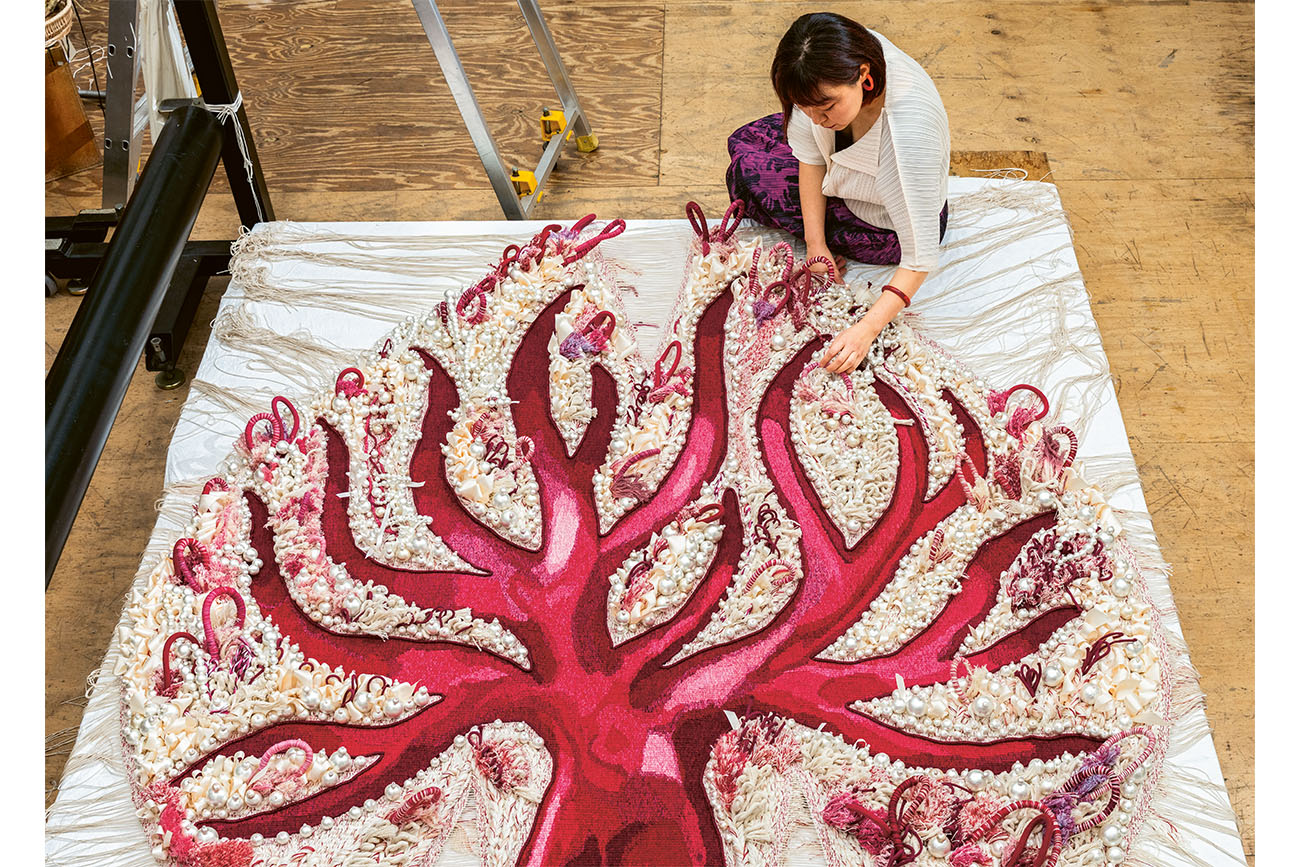
Textiles and crafts have always played an important role in my life. I learned embroidery at the age of eight from a friend’s mother who lived next door. My mother taught me how to crochet by hand and sew on a machine. I grew up in a family of Korean immigrants, so I discovered Korean culture through textiles, such as Korean fabrics, cushions, small drawstring bags, and traditional chima jeogori dresses. In college, I majored in printmaking and continued to practise that art after graduation, but my longstanding interest in embroidery and sewing led me to incorporate textiles into my artwork over the past fifteen years. I shifted almost completely to textile creation after the birth of my two children. Textiles have always been produced by women, often during breaks at work or alone at night; this flexibility suited my new life perfectly, and I found great joy in conceiving pieces as part of a busy and somewhat chaotic lifestyle.

LGT

You often create works using traditional craft techniques such as embroidery, tapestry, and beadwork. How do you determine which method to incorporate into each piece?

ES

The techniques I have adopted in my work came naturally, following my passions and interests. I have great respect for traditional craft processes; I enjoy mastering techniques known as “slow art”. From a contemporary perspective, this art form offers a slow pace and space, which helps us to find value in them. The methods I use also give meaning to my work; the warm, dense colours, as well as the textures and tactility of ancestral forms are an expression of the world I aim to inhabit.

LGT

Could you tell us a little about your creative process?

ES

I usually draw patterns in my sketchbook, adding words that describe the shades or textures. Sometimes the colours inspire me to create something with no particular idea in mind. When embroidering, I don’t plan a specific outcome; instead, I enjoy the freedom of going with the flow. In tapestry weaving, however, I do plan: I prepare the threads, make sketches, and design samples of the colours and textures I will use. I appreciate combining embroidery and tapestry weaving techniques, and I usually work on several projects at once.

LGT

Is there any symbolism behind the choice of colours, given the omnipresence of pink and red in your project for the Biennale of Sydney, and in your work in general?

ES

The colours I use in my creations reflect organs, blood and what lies beneath our flesh. They also symbolize womanhood, based on my personal body experiences. I like to use a palette ranging from white and pale pink to darker shades of maroon and purple. Working on hand-woven textiles is time-consuming: I spent more than 18 months working on the piece displayed at the Biennale of Sydney. Being able to use tints that I am naturally drawn to keeps me engaged and motivated throughout the creative process.

LGT

And how do you decide on the scale and volume?

ES

It depends on the project and where the work will be exhibited, but my current desire is to work on a large scale. It’s always exciting to challenge myself with something new. When I was invited to participate in the Biennale of Sydney, I knew I wanted to create a giant heart, so I approached the Australian Tapestry Workshop (ATW) in Melbourne to consider a collaboration. I started working with ATW in 2012 during a seven-week artist residency. The ATW’s skilled professional weavers manipulate a multitude of colourful wool yarns to produce some truly impressive and monumental two-dimensional tapestries. After my residency there, I realised that tapestry techniques were perfectly suited to the forms and ideas I had imagined, which are now a central aspect of my work.

LGT

Was it a challenge to create a three-dimensional tapestry of this size?

ES

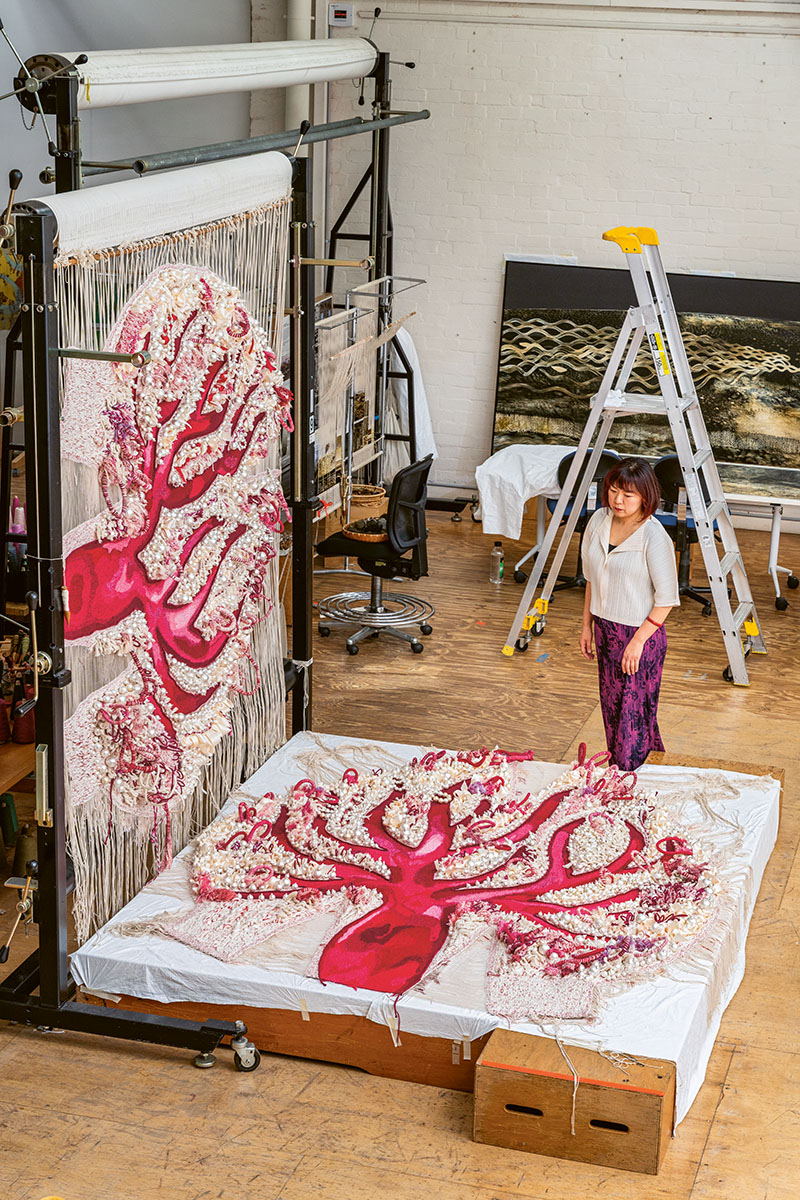
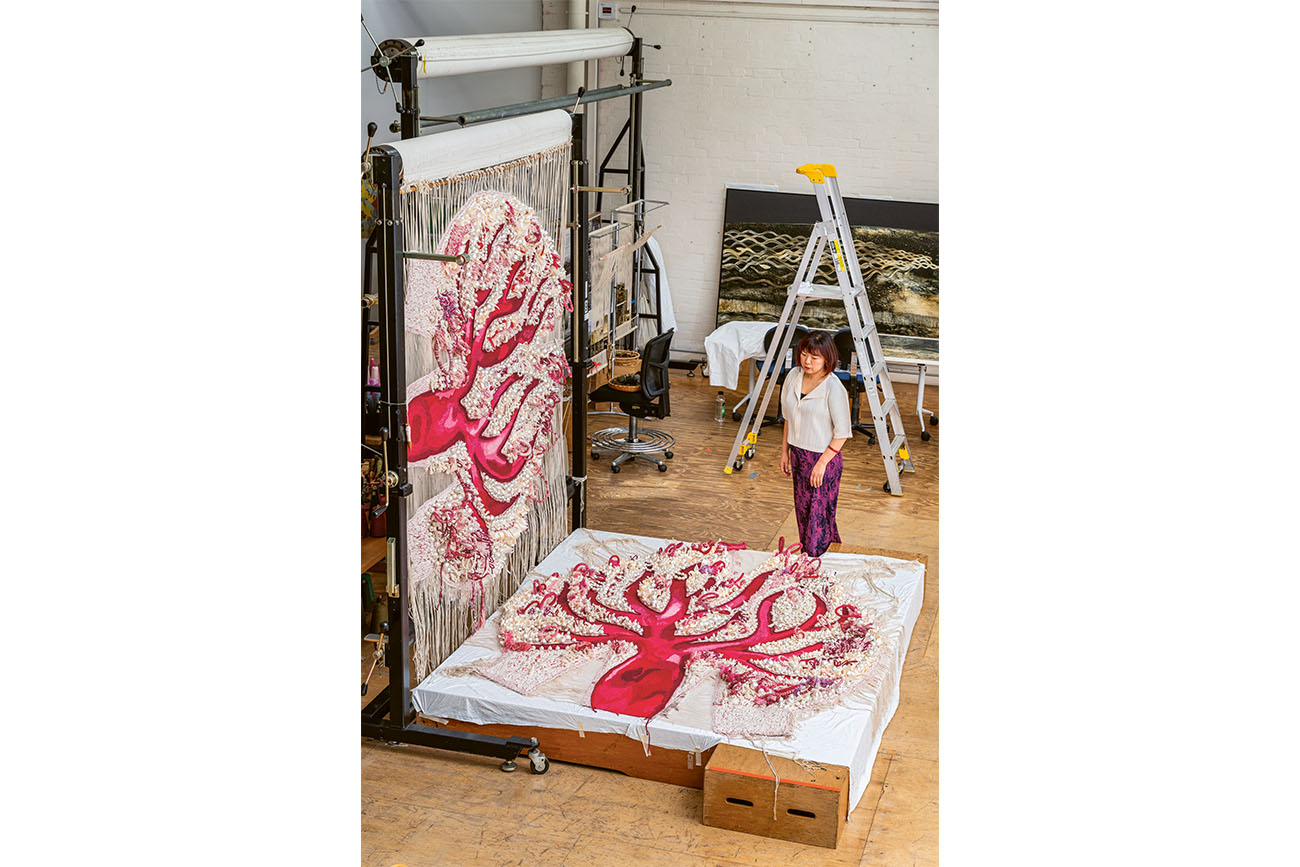
Creating a three-dimensional tapestry required an industrial-scale loom, which presented many challenges in terms of space, materials, time, and personal endurance. Thanks to ATW support, I was able to weave on a loom that was large enough to accommodate the heart design. The sculpture is composed of several pieces that took over a year to complete. Saffron Gordon, a weaver at ATW, assisted me in the process. It was the first time I had ever woven side by side with someone else, and it taught me the value of creative collaboration.

LGT

Has anyone else been involved in this collaborative project?

ES

Yes! The weavers at the Australian Tapestry Workshop helped me prepare the materials, wrap up the loom, and gave me advice on specific techniques. Then dyers at the workshop’s laboratory also assisted me in dyeing the cotton cords. Finally, an engineer from the J. K. Fasham sculpture studio produced the suspension system and metal frame that have been integrated into the work.

LGT

Did the theme of this year’s biennial, Rememory, inspire you?

ES

Time is crucial in my work. When I embroider or weave, I have time to reflect and revisit emotions I have experienced in the past. It is not always easy to remember the past, but reconsidering memories during creation becomes a therapeutic healing process. So yes, rememory is an integral part of my artistic practice.

LGT

What you say about the importance of time and the therapeutic role of creation seem to resonate in these sculptures: as a viewer, one senses that they express a genuine concern for care.

ES

I like creations that have meaning, that are made with dedication and care. I hope my works reflect these qualities. As I said, I am fascinated by historical handicrafts, such as antique quilts or Japanese boro textiles, which are intimate, personal, and designed with care and a lot of love. My art is neither utilitarian nor practical, but I want it to be just as precious.

LGT

There is also something very organic about your work.

ES

The shapes found in nature mesmerise me. I love observing flowers, leaves, pods, nuts, fruits, and the infinite variety of botany. I love following their curves, drawing them, and incorporating them into my artwork. It is fascinating to discover the similarities between human anatomy and plant life.

LGT

There is one thing that we haven’t mentioned yet, but which is fundamental to your artistic practice: your desire to celebrate women’s bodies and sexuality.  

ES

The bodies and reproductive organs in my works are inspired by my personal stories. Although these experiences are deeply intimate, they also resonate universally. Historically, art has often depicted women in idealised portraits created by and for the male gaze, and I wonder if these depictions genuinely reflect real, living women. I believe it is essential to bridge the gap between what is visible and what is invisible.

LGT

Handling such a monumental sculpture requires physical strength, which is far from the image of textile work associated with women’s domestic sphere. Can this be considered a way of subverting the discourse on gendered artistic practices?

ES

From the outset, I knew that this project differed from the traditional domestic environment of women’s handiwork. I first had to resolve two crucial matters: access to a production space and a large-scale loom. However, I did not waver from one of the core concepts of my work; that is, the celebration of womanhood. I did not consider the scale and complexity of creating large-scale pieces as a deterrent or gender-based decision. On the contrary, I believe that artists, regardless of gender, face the same challenges. From this perspective, this work is a contemporary example of gender equality that is part of the broader arts and crafts movement.

LGT

In your opinion, how can this movement change perceptions of textile work, a practice long considered a craft, or a minor art form confined to women?

ES

Textile creation is gaining recognition as a contemporary form of artistic expression. It is no longer considered merely a craft or a minor practice. Many female artists explore women’s history and gender identity, and I am one of them. My work is about the strength and resilience of women. I believe that the diversity of voices can influence the art world and social perceptions. People sometimes share their own experience with me. Once, during an artist talk, a woman told me she had undergone cardiac surgery and no longer liked her heart. But when she saw my work, she felt that her own heart had become precious again. I was really moved by her reaction, and it inspired me to continue making hearts to honour the unwritten stories and resilience of women. 

Ema Shin